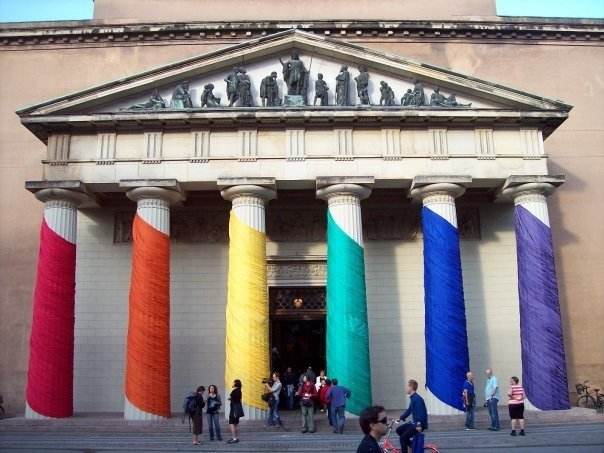
Rev Jide Interviewed In New York

Sunday, 17 May 2009

NIGERIA: IDAHO Press Statement by House Of Rainbow Metropolitan Community Church‏


16th May 2009


Press Statement


Ladies and Gentlemen of the Press


NIGERIA

International Day Against Homophobia and Transphobia 2009.
A Statement by House Of Rainbow Metropolitan Community Church

On behalf of Rev Rowland Jide Macaulay, the founder and Pastor of House Of Rainbow Metropolitan Community Church Nigeria, the leaders, friends and entire members.

We are here today as citizens of Nigeria to add our voice against homophobia and transphobia and to remind our government, religious bodies, media, people and society that they may run us out of their churches, mosques, homes, jobs and neighbourhood, but they cannot run us out of this nation nor reduce the love of God that includes us.

Colossians 3:11, there is no longer Greek and Jew, circumcised and uncircumcised, barbarian, Scythian, slave and free; but Christ is all and in all!

This is a progressive and inclusive voice of scripture rejecting discrimination of any kind.

State Sponsored Homophobia
80 countries around the world consider homosexuality illegal, amongst these five of them punish homosexual acts with death which includes Nigeria.

Romans 13:1-3 Let every person be subject to the governing authorities; (We LGBT citizens have been a subject to the rules of the land) verse three says 3For rulers are not a terror to good conduct, but to bad. (We ask that our government not rule over us in terror for who we are and who we love but judge us on who we hate)

It was not until 1990 that the World Health Organisation removed homosexuality from their list of mental illnesses and, to date Nigerian government still attempt to use the old penal code from British colonialism to punish us, also in 2006 introduced the Same Sex Prohibition bill and 2008 followed up with the Same Gender Prohibition bill, these attempts to punish same sex relationship and union are state sponsored threats against our humanity and we demand an end to this.

Our government also denied we exist on the 9th February 2009 at the United Nations in Geneva and in March 2009 we have to debate that we exist at the parliament.

Yogyakarta Principles on the Application of International Human Rights Law in relation to Sexual Orientation and Gender Identity Principle 21, The Right to Freedom of Thought, Conscience and Religion Says; Everyone has the right to freedom of thought, conscience and religion, regardless of sexual orientation or gender identity. These rights may not be invoked by the State to justify laws, policies or practices which deny equal protection of the law, or discriminate, on the basis of sexual orientation or gender identity.

At House Of Rainbow we believe that building respect for human rights and the rule of law will help ensure the dignity to which every individual is entitled and will halt tyranny, extremism, intolerance, and violence.

We are asking the government to protect people at risk, especially LGBT people, who are increasingly victims of crimes or other mass human rights violations, victims of discrimination, whose rights are eroded in the name of national security and human rights advocates who are targeted for defending the rights of others.

We will continue to fight for equality and for freedom of thought, expression, and religion; by presenting this statement we seek to confront human rights challenges with strategic responses that do not compromise our integrity.
Religious Homophobia
John 9:39-40 Jesus said, ‘I came into this world for judgement so that those who do not see may see, and those who do see may become blind.’ 40Some of the Pharisees near Jesus heard this and said to Jesus, ‘Surely we are not blind, are we?

There is no doubt that many religious communities and leaders chose to alienate us from their mosques and churches, we believe that Jesus spoke of these leaders when he spoke about spiritual blindness.

Religious Homophobia is on the rampage, religious people who are suppose to be God fearing and law abiding have turn their hands to extreme “Hate” Campaign against God’s LGBT children. What then happened to the message of Christ that said “Love your neighbour as yourself?”

We no longer accept discrimination on the grounds that we are an “unacceptable brand of religion in Nigeria”. We seek to exercise our freedom to praise and worship God without fear and discrimination.

Micah 6:8, what is good; and what does the Lord require of you but to do justice, and to love kindness, and to walk humbly with your God?

Homophobia in the Media.
Especially since May 2008, the Nigerian media with its circulation has herald the headship of homophobic stories, headlines range from “Homosexuals Must die” “Evil Church” to “We won’t succumb to Homosexuality”, these medium continue to enhance and incite hatred towards LGBT people, and criminality against our community has increased.
We expect that the media will assist to spread human rights awareness, inform people about human rights, empower marginalized communities to stand up, speak out and protect themselves. The media in any form is one of the most powerful methods to share, educate and inform the people. We are calling on the Nigerian media to help to end hate against LGBT people in this country.

Journalist should strive for Human Right goals and make everyone in the world fully aware of their rights. Creating rights awareness should be the first and most necessary step to ending rights abuses. Shamefully today the Nigerian media is the contrary and have endangered LGBT people’s lives in this nation.

Because of the media, today people "Live In Fear Everyday" it is our aim to put an end to this, LGBT people abroad are not only afraid to return to Nigeria, they do not trust the system and equally those at home are being vilified daily by the media and the society.

House Of Rainbow
We are committed to building a national movement of people who share these principles of equality and freedom for all. We are committed to raise a people of praise, build a people of power and spiritual activists.Within our organization we value learning, mutual respect, collaboration, and a diversity of viewpoints. We are a Justice Ministry and will continue to highlight the injustices against lesbians, gays, bisexuals and transgender people in Nigeria regardless of faith background.

We believe we are made and created in the image of God, we believe in the inclusive gospel and expressive love of God for all people.

The United Nations declaration on sexual orientation and gender identity condemns violence, harassment, discrimination, exclusion, stigmatization, and prejudice based on sexual orientation and gender identity. It also condemns killings and executions, torture, arbitrary arrest, and deprivation of economic, social, and cultural rights on those grounds.

We are asking our government to formally endorse the United Nation’s declaration calling for the decriminalization of homosexuality.

God bless you all


Rev Rowland Jide Macaulay - LLB, MTh, FACTS.
On Behalf of the Leaders, Friends, and Members of
House Of Rainbow Metropolitan Community Church Nigeria

Tuesday, 12 May 2009

Pocket Devotional for LGBT Christians


" This devotional contains a companionable witness for daily 'mountain moving.' Reverend Rowland Jide Macaulay is a dear friend and colleague with a burning love for God's Lesbian, Gay, Bisexual and Transgender people. He often inspires me. He does not shy away from sharing his truth with us, as this is the only way to be completely free, according to Jesus" Reverend Pressley Sutherland.


Click here;


I am very moved by your devotional. I am especially moved by the directness of the appeal to readership that may identify with as a native son of Africa. I hope the book will contribute significantly to the outreach planned in Nigeria,... Rev Pat Bumgardener New York USA.

Monday, 11 May 2009

Letter of Invitation to Press Conference 16th May 2009

Letter of Invitation to Press Conference 16th May 2009

Dear Sir/Ma,
The Independent Project for Equal Rights (TIP) in collaboration with the International Center for Sexual Reproductive Rights (INCRESE) is please to cordially invite you to a press conference to mark the International Day Against Homophobia (IDAHO). This is in an effort to articulate our advocacy against discrimination meted on sexual minorities and people living with disabilities in Nigeria.

Please below are the full details of the event;
Date: Saturday 16th May, 2009
Time: 10am
Venue: AHI Conference Hall- 17 Lawal Street off Oweh street. Jibowu. Yaba. Lagos.
Please kindly confirm your participation as soon as you receive this invitation.

Deadline for confirmation is Wednesday 13th May

Come let's join our hand to fight all forms of discrimination.

For further information, please contact Ohwerhi Efe Brown through 08082685594.
Thank you and we look forward to seeing you.

PS: Note that travel reimbursement will be made.

Thursday, 7 May 2009

Is Homosexuality a Sin?


Is Homosexuality a Sin?by Rev. Dr. Kathlyn James


Rev. Dr. Kathlyn James, First United Methodist Church, SeattleThis sermon was delivered by Rev. James to Lake Washington United Methodist Church in 1997, and is reprinted here with permission.


Last August, we had a special Sunday in church called "Burning Questions," in which I responded, on an impromptu basis, to written questions from the congregation. At that time, I also promised to preach a series of sermons later in the year that would specifically address the top three, or most-asked questions submitted on that day. I have to admit, I could not have predicted the 'top three' questions that would come my way! They were: (1) Is homosexuality a sin? (2) Is there a hell? And (3) How can we forgive? This morning we begin by looking at the first of these: Is homosexuality a sin?

In preparation for today, I gathered together all the materials I could find on this subject. I gathered official denominational studies on homosexuality and the church -- not only the United Methodist study guide, but also documents from the Lutherans, Presbyterians, the United Church of Christ. I also made a stack of books with titles like Living in Sin? by an Episcopal bishop, and Is the Homosexual My Neighbor? by two evangelicals. I eventually had a stack of books and papers a foot deep on my desk. I spent the next several days reading, making notes, and preparing a line of argument for this morning's sermon.

But long about Tuesday of this week, I stopped and asked myself a question. What was my goal -- what is my goal, in addressing this topic from the pulpit this morning?

As your pastor, I know very well that homosexuality is a tender subject among us. It is an issues on which, as Christian people, we have diverse opinions and often very complex feelings. But I also know that this is a real question among us; it is not just a theoretical one. That's why you raised it. There are parents sitting here this morning who are wondering why their child is gay, if it means they've done something wrong, if anyone else has ever struggled with this. There are gay and lesbian Christians who are active members of the church, but who live in the closet because they don't want to lose their jobs, their homes, or your friendship and respect.
There are teenagers here who have contemplated suicide because they suspect they might be gay. Each of us here has our own background, confusion, and experience with this issue. It is time we talked about it.

My goal, this morning is to open the conversation. And this is the thought that occurred to me on Tuesday: what is the best way to begin the conversation? It's not by presenting a logical line of argument. That's how you begin a debate, not a conversation! The best way to begin a conversation, in which you want others to feel free to speak their mind, and no perspective to be silenced, is simply speak from your heart, out of your own experiences.

So let me set aside my pile of books and papers, this morning, and share with you at least part of my own journey around this issue. In the months ahead, beginning with the "dialogue" time immediately following church today, I invite you to do the same.

I grew up in an atmosphere of traditional values. My family belonged to a Congregational church in which, week after week, I absorbed a basically mainline Christian theology that emphasized the love of God for all people I was taught that the most important thing in life is to love God, and to love our neighbors as ourselves. In that environment, oddly enough, I don't remember one word ever being spoken about homosexuality. I don't even know when I first heard the term -- probably not before high school. When I did, it was not with any heavy overlay of negativity -- and in this, I have come to realize, my experience is very different from many people's. I did not grow up being told homosexuality was shameful or sordid; I never had a bad experience such as being molested by a person of my own gender. Only as an adult do I realize what a tremendous impact such early experiences have in shaping people's attitudes toward homosexuality.
In fact, I had never met a homosexual person, as far as I knew, even into my twenties. This combination of influences meant that my attitude was pretty much "live-and-let-live." I didn't see how it hurt anyone, or how it threatened me, if two people of the same sex wanted to love each other and live together. What was the big deal?

It really wasn't until seminary, when I was thirty years old, that the issue acquired a human face for me. Her name was Sally. I was a commuting student at Vancouver School of Theology, with a job and a husband and three children in Seattle. I drove up to Vancouver on Mondays and came home on Wednesdays, so I needed a place to stay two nights a week. Sally had a studio apartment on campus that she was willing to share in return for prorated rent. Over the next three years, Sally and I became fast friends.

I had never met anyone like Sally. For one thing, she was much more disciplined in her spiritual life than I was. She got up at 5:00 every morning, which I thought of as an ungodly hour, and left the apartment for a walk or a bike ride, during which she would pray. She bought all her clothes at Goodwill and had only five changes of clothing and two pairs of shoes in the closet. She spent several days a week volunteering in a soup kitchen downtown. She kept a prayer journal. Basically, she put me to shame. But the most appealing thing about Sally was that she loved God. She laughed easily, loved life, loved people, was funny and fun. One night, as we were going to bed--each of us in a single bed lined against the wall, our heads in the corners and our feet toward each other --she asked if I wanted to pray. I had never prayed with another person before--at least, not like that, opening our inner lives before God, in each other's presence--and at first I was halting and shy. But over time we made a habit of praying together, and it was in the course of those years of praying, of being honest with ourselves as possible in the presence of God, that Sally came out to herself as gay.

It was no problem for me that Sally was discovering this--and I have to add here, that like most people, Sally discovered her sexual orientation; it wasn't something she decided. Isn't that true for you, that your sexual orientation is something that just seems "given"? It wasn't as if Sally woke up one morning and thought, "All things being equal, I think I'd like to be a member of a despised minority." It was more a process of discovering and owning the truth about her make-up as a human being.

But I soon learned what a traumatic discovery that would be. Sally came out first to herself before God, then to her family, then to the seminary, then to the church. I accompanied her in that process. When the Presbyterian Church kicked her out of the ordination process, I was stricken; how could they say that Sally was not qualified to be a pastor? She was the best student in her class, and a better Christian than I ever expect to be. I knew that she had been gifted and called to the ministry. Then Sally was fired from her job as the Youth Director at the church, because someone sent the pastor a letter saying that she was gay. All I could think at the time was; this is absurd, this is evil. Sally is great with those kids; why would people assume she is not safe to work with them? Why did they think a heterosexual man or woman would be safer?

Things came to a head for me, one morning, when I was standing in the kitchen, pouring a glass of orange juice, and listening to Sally cry her eyes out on the bed. She often did, in those days. Finally I went over to her, sat on the edge of the bed, and began to stroke her hair. I was filled with helpless rage at the world, and fierce tenderness for my friend. I heard myself saying, "Sally, I don't know what being gay is. But if it's part of who you are, and if God made you this way, I say I'm glad you are who you are, and I love who you are, and I wouldn't want you to be any different."

As soon as those words were out of my mouth, I realized something. I had taken a stand. I knew where I stood on this issue. Sally did not deserve to be despised and rejected; it was the church who was wrong. After seminary I was appointed to serve Wallingford United Methodist Church in Seattle, which had decided some years earlier to become a reconciling congregation -- that is, a congregation that publicly states it is open and affirming toward all people, regardless of sexual orientation. From that point on, my learning curve was steep! One of my first pastoral calls was to a young man who had just slit his wrists with a razor blade. He explained that he was a Christian and couldn't deny it, that he was also gay and couldn't deny that either, even tough he had tried. He had been told he couldn't be both. His father had called him "human garbage." He was not fit to live. All I could do, in response, was to get down on my knees and ask for forgiveness for the church, for communicating to this young man that he was beyond the reach of God's love.

In the five years that followed, I had many such experiences. I had young men with AIDS look up at me with hollow eyes and ask, "Do you think I am an abomination?" I sat with young men calling for their parents as they died, parents who never came. These experiences had a profound impact on me. I kept going back in my mind, again, and again, to my earliest Christian training; the message that God loves everyone, and that Jesus said to love your neighbor as yourself. He didn't say, "love your neighbor, unless he or she happens to be homosexual." He never said one word about homosexuality at all.

Jesus spent his whole life going to the poor, the marginalized, the persons who were called unclean by their society, and demonstrating that God's love included them. He treated them with compassion. His own harshest words were for the Pharisees who believed that they were righteous in God's eyes, that others were not, and that God's judgments and opinions were identical to their own.

Which brings me to the question of what the Bible has to say about homosexuality. There is not time, this morning, to take up that question in depth -- we will have plenty of time for that later, in ongoing Bible studies and discussion. But let me say a few things here. The world "homosexual" does not appear anywhere in the Bible -- that words was not invented in any language, until the 1890s, when for the first time the awareness developed that there are people with a constitutional orientation toward their own sex.

In the whole Bible, there are only seven brief passages that deal with homosexual behavior. The first is the story of Sodom and Gomorra, which I preached on last fall, which is actually irrelevant to the issue. The attempted gang rape in Sodom has nothing to say about whether or not genuine love expressed between consenting adults of the same gender is legitimate.
Neither does the passage in Deuteronomy 23, which refers to Canaanite fertility rites that have infiltrated Jewish worship. Passages in I Corinthians and I Timothy refer to male prostitution. Two often-quoted passages prohibiting male homosexual behavior are found in the book of Leviticus. Leviticus also stipulates that any man who touches a woman during her menstrual period is to be stoned to death, that adulterers are to be executed, that interracial marriage is sinful, that two types of cloth are not to be worn together, and certain foods must never be eaten.

I know of no Christians, no matter how fundamentalist, who believe that Christians are bound to obey all of the Levitical laws. Instead we are driven to ask deeper questions about how to rightly interpret Scripture, how to separate the Word of God from cultural norms and prejudices -- that is, how to separate the Message from the envelope in which it comes.

The final Biblical text that deals with homosexual behavior is found in Paul's letter to the Romans, in which he unequivocally condemns homosexual behavior. The background for his understanding was the common Roman practice of older males 'keeping' young boys for sexual exploitation, which he was right to condemn.

But even if this were not the case, even if Paul knew about and condemned all forms of homosexual behavior, even the most loving, what then? Paul also told women not to teach, not to cut their hair, not to speak in church. Do we follow his teaching? He told slaves to obey their masters not once, but five times -- are we prepared to say today, as Southern slave owners argued 150 years ago, that slavery is God's will?

The fact is, I am not a disciple of Paul. I am an admirer of Paul, but a disciple of Jesus Christ. Paul himself says that we should not follow him, but Christ alone. So I come back, again to the life and teaching of Jesus as the center of my faith. In that light all other biblical teaching must be critiqued. There are seven passages about homosexual behavior in the Bible, all of which are debatable as to their meaning for us today. There are thousands of references in the Bible that call us, as Jesus commands, to love our neighbor, to work for peace and reconciliation among all people, and to leave judgment to God.

When I was pastor at Wallingford, I put biblical and intellectual foundations under my "heart" experience of knowing Sally. In those years I also came to appreciate a community in which both gay and straight Christians could worship together, serve on the Trustees, sing in the choir -- simply be human together, trying to grow in the capacity to love God and neighbor without fear.
As a result, when you ask me, "Is homosexuality a sin?" My answer today is: "No." I may be wrong, and I ask God's forgiveness if I am. But I don't believe that sexual orientation has anything to do with morality, any more than being blond or tall or left-handed does. Homosexuals as well as heterosexuals can be involved in sexual sin, including promiscuity, infidelity, and abuse. And homosexuals as well as heterosexuals can love one another with faithfulness, tenderness, and integrity. The same standards of moral behavior should apply to Christians, straight and gay. That is what my life experience as a pastor has led me to believe.
When a homosexual couple comes to meet with me in my office, then, and asks, "Will we be accepted in this church?" I can answer, "I will accept you." But I can only speak for myself. What shall I say on behalf of our whole congregation?

Shall I say, "Yes, you will be accepted here, as long as you aren't open about who you are and who you love?" Shall I say, "Yes, you will be accepted here, but you may not serve in any leadership positions." Shall I say, "Yes, you will be accepted here, but whatever you do, don't hold hands in church. Only heterosexual couples are allowed to do that." Shall I just say, "No." Or, perhaps, simply, "Yes."

The only way we will arrive at a consensus on how this question should be answered is by taking time, over the coming year, to examine ourselves, study the Bible, think, read, pray, listen, and share our diverse life experiences with each other, asking together what God is calling this congregation to do and be.

Let the conversation begin.
Amen.

Rev. Dr. Kathlyn James is the Senior Pastor of First United Methodist Church, Seattle, Washington.

Saturday, 2 May 2009

Bishop Yvette Flunder To Receive Clergy Credentials


N E W S R E L E A S E

For Immediate Release


Bishop Yvette Flunder To Receive Clergy Credentialsin Denomination of Metropolitan Community Churches


May 3rd Event In Washington DC Another Step In DeepeningThe Relationship Between MCC, The Fellowship, Says MCC ModeratorWASHINGTON, DC-Bishop Yvette Flunder, presiding bishop of The Fellowship, a movement of churches and faith leaders built on God's radically inclusive love, will receive clergy credentials in Metropolitan Community Churches during events in Washington, DC on Sunday, May 3, 2009. Metropolitan Community Churches is the world's largest and oldest Christian denomination with a primary affirming ministry to lesbians, gays, bisexuals, and transgender persons, along with their families, friends, and allies.
Bishop Flunder, an internationally-known preacher, educator, conference speaker and singer, holds clergy credentials in the United Church of Christ and founded City of Refuge United Church of Christ in San Francisco in 1991. In 2003, she was consecrated Presiding Bishop of The Fellowship, a multi-denominational movement of more than 50 churches and faith organizations in the U.S. and Africa.
Rev. Flunder has served as a consultant to the Centers for Disease Control and Prevention, the Congressional Black Caucus Health Brain Trust and the Department of Health and Human Services. She is the past board president of Justice and Witness Ministries for the United Church of Christ. Bishop Flunder currently serves as a board member of the National Sexuality Resource Center and is a trustee of Pacific School of Religion. Rev. Elder Nancy Wilson, moderator of Metropolitan Community Churches, said, "We share a deep connection with Bishop Flunder and The Fellowship; we share a common calling and a common ministry of inclusive Christianity. In a very real sense, she has been part of our movement for a long time." Both The Fellowship and Metropolitan Community Churches offer positive, welcoming ministry to the LGBT communities and preach an inclusive gospel message. For additional information on the intentional relationship-building between the two faith organizations, read "From Cooperation to Collaboration: Growing Relationship Between MCC and the Fellowship "
"In ordaining Bishop Flunder as clergy within Metropolitan Community Churches, we affirm our trust in her ministry in the Fellowship," added Rev. Wilson. "We know that the same Spirit that animates MCC animates the Fellowship; we are one in Christ. We value Bishop Flunder's ministry, celebrate her calling, and honor her contributions to us."In remarks this week, Bishop Flunder noted, "For years I have deeply appreciated the contribution of Metropolitan Community Churches to the 'Jesus' work of ending injustice everywhere. The justice work of MCC has not been limited to extending God's Extravagant Grace to sexual minority communities; it has also made a significant impact in bringing an end to racism, sexism, patriarchy and war. This is a Church that had its beginnings in the fire of Pentecostalism and political awareness...Spirit and Truth. I am thrilled to embody a connection between the United Church of Christ, The Fellowship and Metropolitan Community Churches...great justice movements of our time."
Rev. Wilson indicated that she will also seek clergy credentialing with The Fellowship "as part of our ongoing commitment to strengthen and deepen the relationship between our two movements." Bishop Flunder is a graduate of the Ministry Studies and Master of Arts programs at the Pacific School of Religion, Berkeley, California, and holds the Doctor of Ministry degree from San Francisco Theological Seminary, San Anselmo, California. She is the author of Where The Edge Gathers: Building A Community of Radical Inclusion. MCC clergy credentials will be conferred upon Bishop Flunder during the 11 am worship service of Metropolitan Community Church of Washington, DC, 474 Ridge Street NW, Washington, DC 20001 where Rev. Dr. Charlie Arehart is interim pastor. The occasion will mark the first time since 2005 that MCC has extended extraordinary credentials, and the first during the tenure of Rev. Nancy L. Wilson as MCC Moderator. ( E N D )
To Arrange Media Interviews
With Bishop Yvette Flunder,
Contact:Franzetta Houston
Assistant to the Bishop
Tel. (415) 350-3350E-mail: TheFellowship@pacbell.net
To Arrange Media Interviews
With Rev. Elder Nancy Wilson,
Contact:Jim BirkittCommunications Director
Metropolitan Community Churches
Tel. (310) 625-4177E-mail: info@MCCchurch.net

Tuesday, 14 April 2009

UGANDA: When Christians condemn God’s children during the Easter season

When Christians condemn God’s children during the Easter season

http://www.monitor.co.ug/artman/publish/Tabaire/When_Christians_condemn_God_s_children_during_the_Easter_season_82994.shtml

It is Holy Saturday, today, the final day of Holy Week and of Lent – “a period of spiritual preparation for Easter which typically involves fasting, penance and prayer”.
Besides fasting, penance and prayer, the Lent period in Uganda this year has been characterised by something else: virulent gay-bashing.

This is a project that has been, and is still being, championed by “serious” Christians such as Mr Stephen “Heterosexual” Langa of the Family Life Network and Pastor Martin “Heterosexual” Ssempa of Makerere Community Church. And yet we are all, in our ‘sinning’ difference, God’s children! What happened to tolerance and understanding as cherished values in Christ’s church and civilised society in general?

Well, homosexuality is illegal in Uganda. That much, even if nonsensical, is clear. What is not clear is Mr Langa’s bigoted behaviour and how he goes about displaying it. He seems to have unilaterally declared 2009 the Year of Homophobia in Uganda. He spent much of March parading several men (and why no women?) who claimed they are reformed homosexuals. Good for them.

But here are some questions. Where did Mr Langa find these eight-plus men, led by George “Georgina” Oundo? What attracted these men to Mr Langa and not Archbishop Luke Orombi, for example? Had he all along known them to be gay? Or had he planted them in the local gay community in the first place as part of a plan to undermine gays and lesbians in Uganda? Do the police have any reason to not look closely into the activities of the Family Life Network?
More disturbing are the allegations that the men, especially Georgina Oundo and Emma Matovu, are making. They say they were engaged in “recruiting” school children into homosexuality using money from the immoral Western world. Fine.

But enticing minors into sexual activity, any sexual activity, is illegal as well. So why are the Georginas not reporting this matter to the police? Why do they report to Mr Langa’s little outfit? If they do not know about the rights of children, surely, Mr Langa knows. Why does he then not encourage them to report these things to the police?

In fact, the police should swing into action and arrest anyone, straight or gay, who has lured children to sexual activity. Otherwise they will stand accused of going along with Mr Langa’s posturing as the guarantor of morality in Uganda.

Indeed, the main point that has come out of Mr Langa’s shrill anti-gay crusade is that adults are messing with our children. This, though, begs the question: what has recruitment of children into homosexuality got to do with two consenting adults having a sexual relationship? In his zeal, Mr Langa appears over his head here. He needs to straighten his priorities not gays and lesbians.
Another significant aspect out of the confessions is that money is pouring in from the West to promote homosexuality. The real message is that if there was no money from outside, no Ugandan would be lesbian or gay or bisexual or transgender.

How fanciful! Let us grant for a moment, however, that the argument is correct. How then to explain “former homosexual” Charles Asiimwe’s statement that “many business moguls are involved” in homosexuality? If being gay is about making money, why would business moguls be gay? How much more money can a mogul possibly make from Western handouts by being gay? Or did these moguls become wealthy because they are gay?

“We shall expose those who refuse to abandon the practice and we shall not be intimidated because we are protected by Jesus,” Georgina thundered at one of many recent Langa-organised public spectacles.

There is something potentially dangerous in what Mr Langa is doing in inveighing against fellow Ugandans just because they are not heterosexual. It will come as no surprise if individuals falsely name others as gay or lesbian to settle personal scores.

A Catholic priest, Fr Anthony Musaala, has already been named. He has strongly denied that he is gay saying he ministers to all irrespective of sexual preference – as it should be – and his parish of St. Matia Mulumba in Old Kampala has defended him. Kampala Archbishop Cyprian Lwanga, however, appears unimpressed and is going ahead with an investigation.
Worse could happen. On Tuesday, The New York Times published a story out of Iraq. The first two paragraphs read thus: “The relative freedom of a newly democratic Iraq and the recent improvement in security have allowed a gay subculture to flourish ... The response has been swift and deadly.

“In the past two months, the bodies of as many as 25 boys and men suspected of being gay have turned up in the huge Shiite enclave of Sadr City, the police and friends of the dead say. Most have been shot, some multiple times. Several have been found with the word “pervert” in Arabic on notes attached to their bodies, the police said.”

I hope fasting, penance and prayer truly mean something to Mr Langa, Pastor Ssempa and Ethics Minister Nsaba Buturo. Happy Easter to you all. Irrespective of sexual orientation.
bentab@hotmail.com

Saturday, 11 April 2009

Anti-Gay Bullying Claims Another Young Life


Anti-Gay Bullying Claims Another Young Life.
See the story below, I could not help my self this morning, hopelessly I shed tears in my pain and anguish, this could have been my child, this young boy was defenceless against the torrent of abuses and the only way out for him was to take his life.
Our community from Nigeria to the USA, mourn yet another loss and we continue to hold Carl's family, friends, allies and the entire Global LGBT communities in our prayers, we send prayers of hope throughout the world to all people trapped in painful and dangerous situation. As a gay man from Nigeria and also a Christian leader, our work is to continue the effort to educate all people everywhere.

Another tormented grade schooler, another little kid who thinks there's only one way out. "An 11-year-old Massachusetts boy, Carl Joseph Walker-Hoover, hung himself Monday after enduring bullying at school, including daily taunts of being gay, despite his mother’s weekly pleas to the school to address the problem. This is at least the fourth suicide of a middle-school aged child linked to bullying this year. Carl, a junior at New Leadership Charter School in Springfield who did not identify as gay, would have turned 12 on April 17, the same day hundreds of thousands of students will participate in the 13th annual National Day of Silence by taking some form of a vow of silence to bring attention to anti-LGBT (lesbian, gay, bisexual and transgender) bullying and harassment at school. The other three known cases of suicide among middle-school students took place in Chatham, Evanston and Chicago, Ill., in the month of February." [GLSEN]
Other links with this story;